


YouTube Creator Ecosystem Contributes Over Rs 18,000 Crore to India’s GDP in 2025
-
Khushi Jain

- October 1, 2026
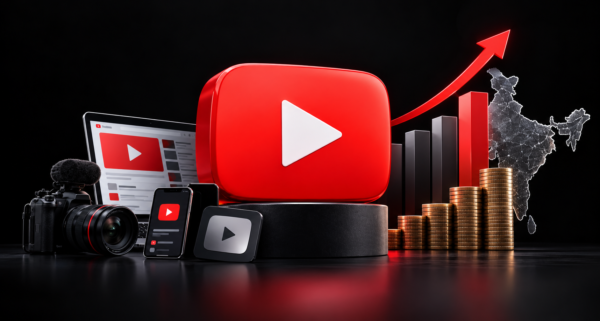
YouTube’s creator ecosystem contributed more than Rs 18,000 crore to India’s GDP in 2025 and supported the equivalent of over 960,000 full-time jobs, according to the Google-owned video platform’s 2025 India Impact Report.
The report, based on research by economic consulting firm Oxford Economics, was released on Tuesday at the YouTube Impact Summit 2026 in New Delhi.
In the previous report covering 2024, YouTube’s ecosystem was estimated to have added over Rs 16,000 crore to GDP and supported more than 930,000 full-time equivalent (FTE) jobs. This represents a year-on-year rise of roughly 12% in GDP contribution and about 3% in jobs.
The jobs counted include cinematographers, sound engineers, scriptwriters and other production staff, YouTube said.
YouTube’s Economic Contribution Since 2020
Oxford Economics’ first India study, published in March 2022, estimated that YouTube’s creator ecosystem contributed Rs 6,800 crore to India’s GDP and supported 6,83,900 FTE jobs in 2020.
Based on these figures, the ecosystem’s estimated GDP contribution has grown more than two and a half times in five years, while the job estimate has risen by roughly 40%.
The number of YouTube channels in India generating six figures or more in rupee revenue increased by over 30% year-on-year, according to the report.
Among creators earning money from the platform, 73% said YouTube was their primary source of income, up from nearly two-thirds in the report covering 2024. The report also found that 93% of creators with a career in media or entertainment started that career on YouTube.
Indian channels uploaded more than 160 million hours of content in the past year. More than 15% of watch time on content made by Indian channels came from viewers outside India, while 81% of media companies with a YouTube channel said the platform helped them reach new audiences around the world.
The report cited Marathi singer Sanju Rathod, whose song “Gulabi Sadi” crossed 500 million views, as an example of regional-language content reaching audiences abroad.
Jobs and Businesses Beyond Creators
Creators earning money on YouTube supported more than 300,000 apprentices in the past year, according to the report.
The report said creators are hiring video editors, camera operators and scriptwriters, and pointed to creative clusters emerging in non-metro cities such as Jaipur, Lucknow and Kochi.
It also cited SimpleGhar, a product review channel that started in late 2022 with one camera in a converted home studio. The channel has since grown into a media company with a 35-member full-time team producing content in seven languages.
Among small and medium-sized businesses with a YouTube channel, 73% said their presence on the platform helped them grow their business beyond YouTube.
YouTube framed these figures as part of India’s “Orange Economy”, a creative economy built around content, creativity and culture, and linked it to the government’s Viksit Bharat goal.
India’s Growing Creator Economy
The report comes as India’s creator base continues to expand. A report by the Indian School of Business and Hashfame, released in July 2026, found that the number of creators in India rose more than fourfold, from about 0.96 million in 2020 to 4.12 million in 2025. The study found that 66% of creators now come from non-metro markets.
Average creator engagement rose from 1.8% to 7.2% over the same period, while annual brand campaigns with creators increased from about 14,000 to 42,000.
“The more important challenge now is enabling creators to build sustainable businesses,” said Madhu Viswanathan of ISB.
Child Safety in Focus
YouTube also used the report to highlight its safeguards for younger users, a day after the Supreme Court took up the question of minors on social media.
On 28 September, a Bench led by Chief Justice Surya Kant, hearing a public interest litigation filed by the Just Rights for Children Alliance, asked the Centre to examine statutory safeguards for users below 18.
These include whether platforms should be stopped from allowing minors to independently create accounts, and whether parental consent or age verification should be required.
“Guidelines are mere guidelines. It should be in some statutory format,” Justice Joymalya Bagchi said.
Solicitor General Tushar Mehta told the court that the Centre would amend the IT Rules to make it a statutory obligation for platforms to prevent users under 18 from creating accounts.
Separately, under the Digital Personal Data Protection Rules notified in November 2025, platforms will need verifiable parental consent to process the data of anyone under 18 from 13 May 2027.
YouTube said its products are “age-appropriate by design”, pointing to YouTube Kids, supervised accounts and parental controls.
According to the report, 74% of parents who use the platform consider YouTube or YouTube Kids for children under 13 important to their children’s discovery of the world.
It also cited an August 2025 survey by Ipsos in India, in which 92% of parents of 10 to 17-year-olds who had used supervised-account tools agreed that the content their child viewed was appropriate for their age.
YouTube’s AI and Creator Initiatives
YouTube said it will focus on three areas in India, including AI-powered creation tools, ecosystem partnerships and responsible AI.
The tools include conversational AI editing in Shorts and agentic channel management through Ask Studio.
Partnerships include a skilling programme called Create with AI, run with the Ministry of Information and Broadcasting and the Indian Institute of Creative Technologies.
On responsible AI, the company pointed to AI Likeness Detection, which is meant to give creators more control over their digital presence.
The plans build on commitments made by YouTube CEO Neal Mohan at the WAVES summit in Mumbai in May 2025. At the summit, he said YouTube had paid more than Rs 21,000 crore to creators, artists and media companies in India over the previous three years, and would invest over Rs 850 crore in the following two years to accelerate their growth.
FAQs
1. How much did YouTube’s creator ecosystem contribute to India’s GDP in 2025?
YouTube’s creator ecosystem contributed more than Rs 18,000 crore to India’s GDP in 2025.
2. How many full-time jobs did YouTube’s creator ecosystem support in 2025?
The ecosystem supported the equivalent of over 960,000 full-time jobs.
3. How many creators were there in India in 2025 according to the ISB and Hashfame report?
The report found that the number of creators in India rose to 4.12 million in 2025.
4. What are some of YouTube’s planned initiatives in India?
YouTube plans to focus on AI-powered creation tools, ecosystem partnerships and responsible AI.
5. When will platforms need verifiable parental consent for users under 18?
Under the Digital Personal Data Protection Rules notified in November 2025, platforms will need verifiable parental consent to process the data of anyone under 18 from 13 May 2027.