


India-UK Trade Deal: Bulk Scotch Tariff Dispute
-
Khushi Jain

- November 2, 2026
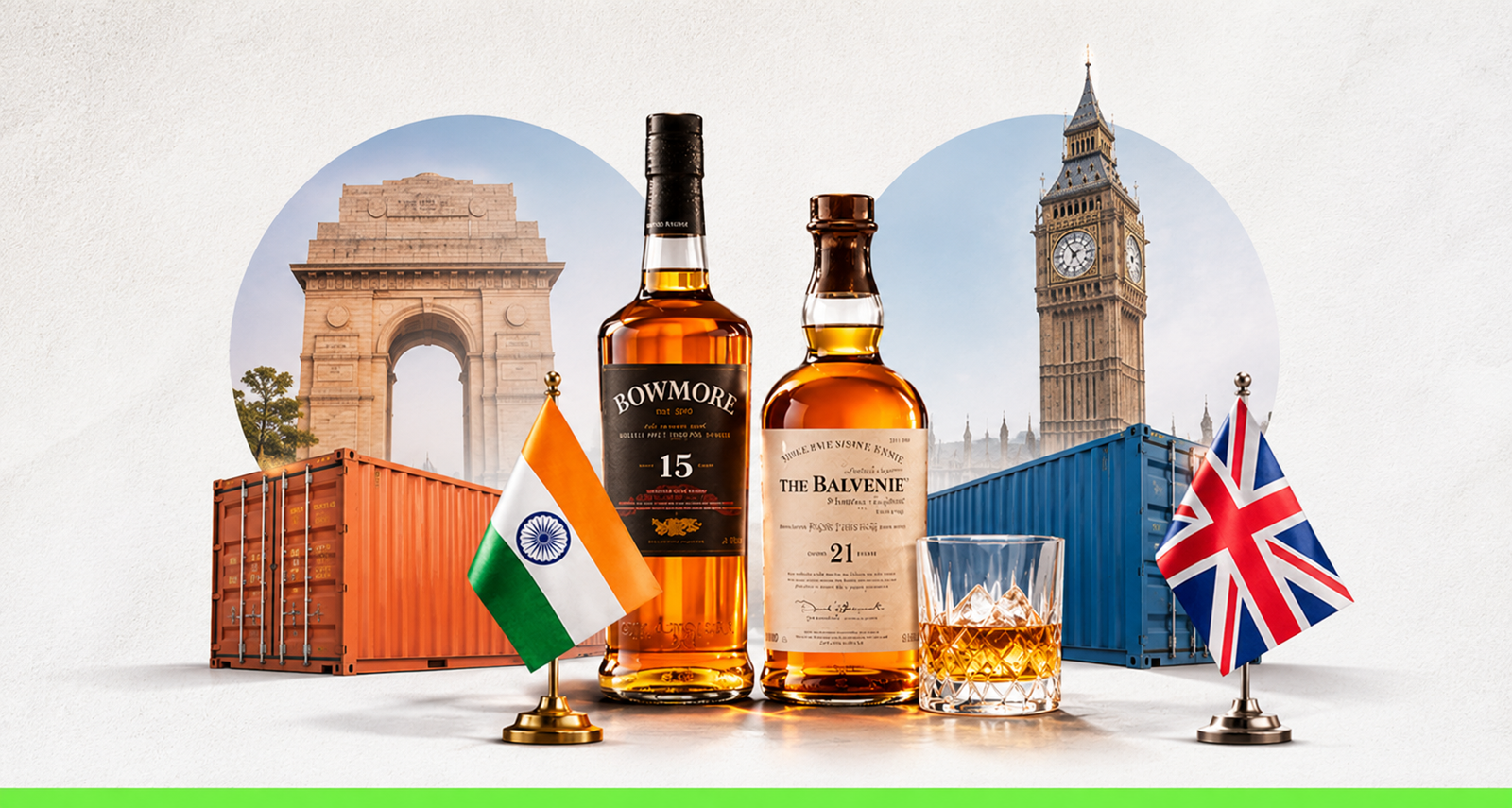
A dispute has emerged over customs duties on bulk Scotch whisky imports under the India-UK trade agreement, with Indian authorities maintaining that certain imports do not qualify for the reduced 75% tariff.
The Indian government has privately argued with companies including Diageo, Pernod, Radico Khaitan and Allied Blenders and Distillers that their bulk Scotch imports remain subject to the earlier 150% tariff, according to Reuters.
The disagreement centres on the customs classification of bulk Scotch whisky, which is widely used by Indian liquor manufacturers to produce domestic whisky brands.
Under the India-UK trade agreement, which took effect on July 15, import duties on certain Scotch whisky products were reduced from 150% to 75%, with a further reduction to 40% over 10 years.
The British government said iconic UK products, including whisky and gin, would benefit from India’s tariff changes.
Although Indian state taxes and other levies remain high and vary across the country, the duty reduction was expected to provide some price relief for whisky products.
Why India and Whisky Companies Disagree Over Import Tariffs
Indian officials argue that while bottled Scotch whisky, including The Glenlivet, qualifies for the reduced tariff, bulk Scotch imports used in domestic whisky production do not.
This position has raised concerns among liquor manufacturers because the trade agreement’s tariff schedule also covers Scotch imported in bulk.
According to a Reuters report on India’s investigation into bulk Scotch imports, tax officials have searched the offices of several companies in recent weeks as part of the investigation.
Authorities maintain that a customs classification introduced earlier this year for “compound alcoholic preparations of a kind used for the manufacture of beverages” applies to the bulk imports under investigation.
Under this classification, the imports would attract the earlier 150% tariff rather than the reduced 75% rate.
However, liquor companies disagree with the government’s interpretation.
“Compound alcoholic beverages are essentially flavoured or modified alcohols, whereas bulk Scotch Whisky is a distilled alcoholic beverage produced with malted barley and water,” said Rajnish Singh, founder of Yaana Advisors, which advises liquor companies on regulatory matters.
The Indian government is expected to hold discussions with industry representatives to address the disagreement.
Why Bulk Scotch Whisky Imports Matter to India
India is the largest export market for Scotch whisky by volume.
According to the Scotch Whisky Association’s data on the Indian market, the equivalent of more than 220 million bottles of Scotch whisky was exported to India in 2025.
Industry estimates indicate that approximately 80% of Scotch whisky imports from Britain by volume arrive in bulk rather than as finished bottled products.
These imports are primarily used to manufacture Indian-Made Foreign Liquor (IMFL) whisky, which is produced by blending Scotch with other spirits and ingredients.
Several Indian and international companies, including Pernod and Diageo, sell whisky brands made using this process.
For example, Pernod’s Blenders Pride is described on the company’s website as a blend of Indian grain spirit and imported Scotch malts from Chivas Brothers, developed for Indian whisky consumers.
The classification of bulk Scotch imports therefore has implications for companies that use imported whisky in their domestic manufacturing operations.
UK Government Raises Concerns Over Tariff Treatment
The disagreement has also drawn attention from the British government.
Following a Reuters report last month about Indian authorities’ scrutiny of liquor companies, a UK government spokesperson said:
“We are working with the government of India to resolve this issue to ensure UK businesses can export under the tariffs agreed in the trade deal.”
Scotland’s leader John Swinney also raised the treatment of bulk Scotch whisky exports with the Indian government during a visit that ended last week.
The Indian government has not commented publicly on the matter so far.
Liquor Industry Warns of Impact on Domestic Manufacturing
The International Spirits & Wines Association of India, which represents Pernod, Diageo and other major companies, has privately expressed concerns that the classification dispute could undermine an important market-access benefit negotiated under the India-UK agreement.
The Confederation of Indian Alcoholic Beverage Companies, a domestic industry association, has also raised objections, citing potential consequences for local manufacturing.
As reported by The Economic Times in its coverage of the industry’s concerns, the association warned that excluding bulk Scotch from the reduced tariff could encourage imports of finished whisky instead of supporting production within India.
The industry group argued that such an outcome would run counter to the country’s domestic manufacturing objectives.
Meanwhile, Allied Blenders and Distillers said in an investor presentation last week that it is “one of the largest bulk Scotch importers”.
The company also stated that the India-UK agreement would improve its “luxury portfolio accessibility”.
The dispute remains unresolved, with discussions expected between Indian authorities and the liquor industry over the applicable customs classification and tariff treatment.
Frequently Asked Questions (FAQs)
1. What is the dispute over bulk Scotch imports in India?
Indian authorities argue that certain bulk Scotch imports do not qualify for the reduced 75% tariff under the India-UK trade agreement. Liquor companies disagree with this classification.
2. What tariff applies to bulk Scotch imports under investigation?
Indian officials maintain that the earlier 150% tariff applies to these imports rather than the reduced 75% rate.
3. How much Scotch whisky was exported to India in 2025?
India received the equivalent of more than 220 million bottles of Scotch whisky in 2025, according to the Scotch Whisky Association.
4. Which companies are involved in the tariff dispute?
Companies mentioned include Diageo, Pernod, Radico Khaitan and Allied Blenders and Distillers.
5. Why are Indian liquor companies concerned?
Industry groups warn that excluding bulk Scotch from the tariff reduction could encourage finished whisky imports and affect domestic manufacturing.