


AI Holiday Planning: Can AI Replace Travel Agents?
-
Khushi Jain

- November 26, 2026
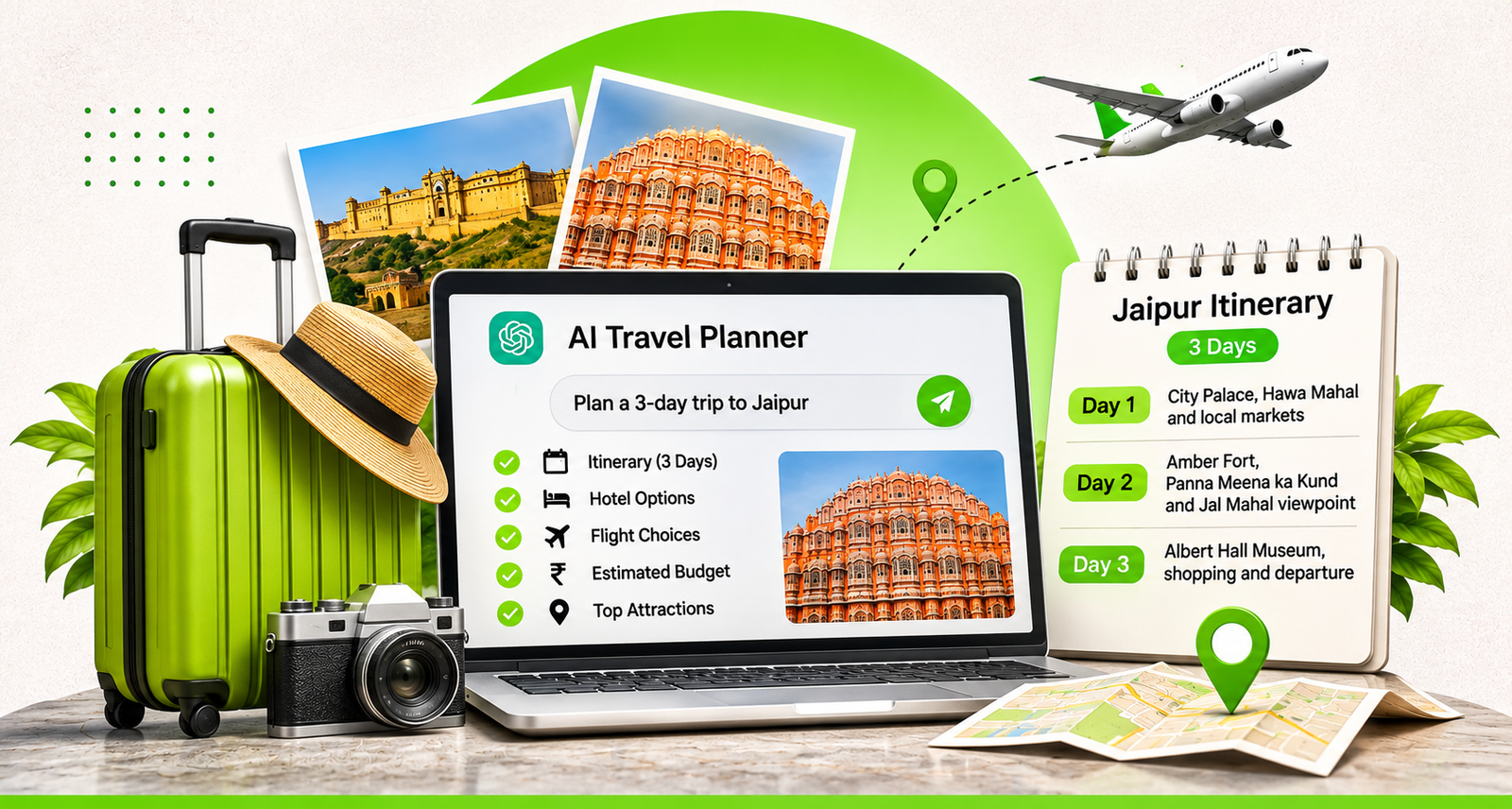
Planning a holiday often involves hours of research. Travellers compare flight prices, read hotel reviews, search for places to visit and work out how much the trip will cost. Artificial intelligence (AI) is making many of these tasks easier by allowing users to plan their journeys through a conversation.
Instead of visiting several websites, travellers can describe their ideal holiday, set a budget and receive a personalised travel itinerary.
According to Google Trends India, published on 23 November 2026, searches for “AI for Travel” in India increased by 600% over the previous year. While search interest does not measure actual usage, it indicates growing curiosity about AI-powered travel services.
Companies including MakeMyTrip, Google, Booking.com and Expedia are already introducing AI tools that help customers research, plan and book holidays. blog.google+3
But can these tools manage an entire holiday without a travel agent?
What Is an AI Travel Planner?
An AI travel planner is a digital tool that helps travellers organise trips based on their budget, travel dates, interests and personal requirements.
Users can communicate in everyday language instead of manually applying multiple search filters.
For example, someone planning a four-day family holiday can ask AI to recommend a destination, prepare an itinerary, suggest accommodation and estimate daily expenses.
The traveller can then modify individual parts of the plan without repeating the entire search process.
8 Ways AI Can Help Plan Your Entire Holiday
1. Finding the Right Travel Destination
Choosing a destination can be difficult when travellers have limited holidays or a fixed budget.
AI can compare destinations based on travel costs, seasonal weather, available activities and transport connectivity. It can also suggest alternatives to expensive or overcrowded tourist destinations.
Example: A couple from Ahmedabad with a budget of Rs 35,000 can ask AI to compare Udaipur, Mount Abu and Kutch for a four-day holiday.
The tool can explain the differences between these destinations and help the couple decide which suits their preferences.
2. Finding Affordable Flights and Transport
AI-powered travel platforms can help travellers compare flight options, identify cheaper travel dates and explore alternative routes.
Google’s Flight Deals uses AI to understand conversational flight searches. Travellers can describe their requirements rather than entering a fixed destination at the beginning of their search.
Example: A traveller can ask for an affordable return flight from Mumbai to a beach destination in January, with no more than one stop.
An AI tool connected to live flight data can identify suitable options. Travellers should still check the final fare, baggage allowance and cancellation charges before booking.
3. Finding Hotels That Match Your Requirements
Hotel booking involves more than comparing room prices. Location, facilities, food preferences, accessibility and cancellation policies also affect the decision.
AI can narrow down accommodation options based on these requirements.
On 7 August 2025, MakeMyTrip announced a generative AI upgrade to its existing travel assistant, Myra. The service supports conversational travel planning through text and voice.
The introduction of AI services is part of the wider development of India’s online travel booking industry.
Example: A family travelling to Jaipur can ask for hotels under Rs 3,000 per night with breakfast, parking and easy access to tourist attractions.
AI can shortlist suitable properties, although facilities and room availability should be confirmed before payment.
4. Creating a Day-by-Day Travel Itinerary
AI can organise sightseeing, activities and travel routes according to the number of days available.
Travellers can request a relaxed schedule, avoid long journeys or include activities suitable for children and elderly family members.
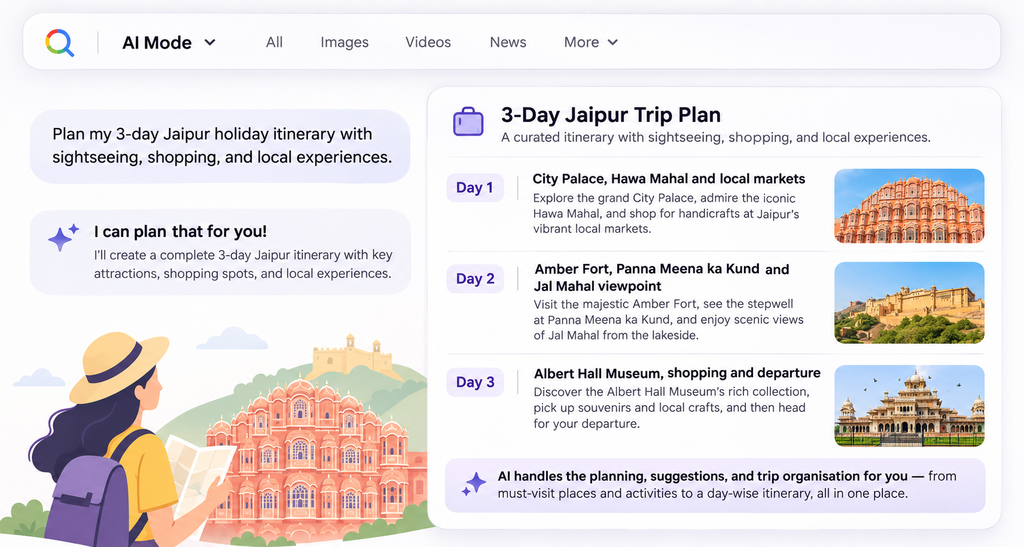
Example: A three-day Jaipur holiday planned using AI.
| Day | Suggested activities |
|---|---|
| Day 1 | City Palace, Hawa Mahal and local markets |
| Day 2 | Amber Fort, Panna Meena ka Kund and Jal Mahal viewpoint |
| Day 3 | Albert Hall Museum, shopping and departure |
This is an illustrative itinerary. Opening hours, entry fees and travel times should be checked before travelling.
5. Managing the Holiday Budget
AI can divide a holiday budget into different expenses, helping travellers understand how much they can afford to spend on accommodation, transport, food and activities.
It can also suggest ways to reduce expenses without changing the entire holiday plan.
Example: A couple planning a five-day holiday in Kerala with a budget of Rs 50,000 could allocate their expenses as follows:
| Expense | Estimated budget |
|---|---|
| Travel tickets | Rs 15,000 |
| Accommodation | Rs 14,000 |
| Food and beverages | Rs 7,000 |
| Local transport | Rs 6,000 |
| Sightseeing | Rs 5,000 |
| Emergency expenses | Rs 3,000 |
| Total | Rs 50,000 |
These figures are illustrative budget allocations and do not represent current market prices.
6. Understanding Visa and Travel Requirements
AI can help international travellers understand the documents they may need, including passports, visas, travel insurance and proof of accommodation.
However, visa rules can change, and AI-generated information may be outdated.
Example: An Indian passport holder planning a holiday in Japan can ask AI to prepare a visa application checklist.
Before submitting an application, the traveller should verify the requirements through the Japanese embassy or the Ministry of External Affairs
7. Finding Local Experiences and Food Options
AI can recommend restaurants, markets, museums, cultural activities and other experiences based on individual preferences.
Google Maps also offers conversational search through Ask Maps in India, allowing users to make more detailed location-based enquiries.
Example: A vegetarian traveller visiting Kochi can ask AI to find suitable restaurants near their hotel, along with local markets and cultural activities.
Restaurant opening hours, menus and dietary requirements should still be confirmed directly.
8. Managing Unexpected Changes During a Trip
Weather conditions, transport delays and cancelled activities can disrupt a carefully organised holiday.
AI can suggest alternative activities and help travellers rearrange their schedules.
Example: If heavy rain interrupts a beach holiday in Goa, a traveller can ask AI to suggest indoor activities, museums or alternative places to visit.
However, flight cancellations, refunds and emergency arrangements should be handled directly with the relevant travel provider.
How Many Travellers Are Using AI for Travel Planning?
In April 2026, Expedia Group published its AI Trust Gap report, based on research conducted by YouGov among more than 5,700 adults across India, the UK and the US.
The research found that travellers were interested in using AI for holiday planning, although many preferred established travel companies when making payments.
AI Adoption and Trust in Travel Planning
Percentage of surveyed travellers
The findings suggest that travellers are more comfortable using AI to research holidays than allowing it to make purchases on their behalf.
Best AI Tools for Travel Planning
| AI travel tool | Main purpose |
|---|---|
| ChatGPT | Itinerary planning and budget preparation |
| Google Gemini | Travel research and personalised recommendations |
| Google Flights | Flight discovery and price comparison |
| MakeMyTrip Myra | Conversational travel planning and booking assistance |
| Booking.com | Accommodation discovery and trip planning |
| Expedia | Travel research, booking and trip management |
The availability of AI features and direct booking services varies by country and platform.
AI Travel Planner vs Traditional Travel Agent
| Feature | AI travel planner | Travel agent |
|---|---|---|
| Planning speed | Usually within minutes | Depends on trip requirements |
| Availability | Generally 24/7 | Depends on agency |
| Personalisation | Based on user instructions | Based on consultation |
| Booking support | Platform-dependent | Usually available |
| Visa assistance | General guidance | Specialised assistance may be available |
| Planning fees | Free or subscription-based | Fees or commissions may apply |
| Emergency assistance | Limited or platform-dependent | Depends on service agreement |
AI is useful for independent travellers who are comfortable researching and confirming their own bookings. Travel agents may be more suitable for complicated international holidays, large groups and journeys requiring additional support.
Limitations of AI Travel Planning
AI-generated travel plans can contain incorrect or outdated information. Travellers should be particularly careful about:
- Incorrect flight schedules and hotel prices.
- Outdated visa and entry requirements.
- Unrealistic travel times between attractions.
- Inaccurate restaurant and hotel recommendations.
- Limited support during emergencies.
- Privacy risks when sharing payment or passport details.
A suggested hotel or flight should never be treated as a confirmed reservation without an official booking confirmation.
Opportunities for AI Travel Startups in India
AI presents new business opportunities within the Indian travel and hospitality industry.
Startups could develop regional language travel assistants, automated itinerary planners, price-tracking services and specialised booking platforms.
Established companies are also investing in AI travel technology. On 31 July 2026, Expedia Group announced its acquisition of Layla, an AI-powered travel planning and booking platform.
The acquisition provides an example of how conversational travel planning is becoming part of established online travel businesses.
Can AI Completely Replace Travel Agents?
AI can help organise almost every stage of a holiday, from choosing a destination to preparing an itinerary and comparing booking options.
For straightforward holidays, travellers may be able to manage the entire process without a traditional travel agent.
However, AI cannot guarantee the accuracy of every recommendation or resolve every unexpected problem. Professional travel assistance remains useful when journeys involve complicated bookings, visa requirements or emergencies.
For now, using AI to prepare a holiday plan and trusted travel providers to confirm reservations offers a practical balance between convenience and reliability.
Frequently Asked Questions (FAQs)
1. Can AI plan an entire holiday without a travel agent?
Yes. AI can recommend destinations, prepare itineraries, estimate expenses and help travellers discover booking options.
2. Which AI tool is best for travel planning in India?
ChatGPT, Google Gemini and MakeMyTrip Myra offer different travel planning features. The most suitable tool depends on individual requirements.
3. Can AI book flights and hotels?
Some AI platforms support integrated booking services. Others provide recommendations and redirect travellers to booking websites.
4. Is AI travel planning free?
Many AI tools offer free planning features, while some advanced features require paid subscriptions.
5. Is it safe to use AI for holiday planning?
AI is useful for travel research, but travellers should independently verify prices, booking details, visa requirements and safety information.