


India’s 10 Inspiring D2C Brand Founders Shaping the Future of Consumer Brands in 2026
-
Mitali Sharma

- September 25, 2026
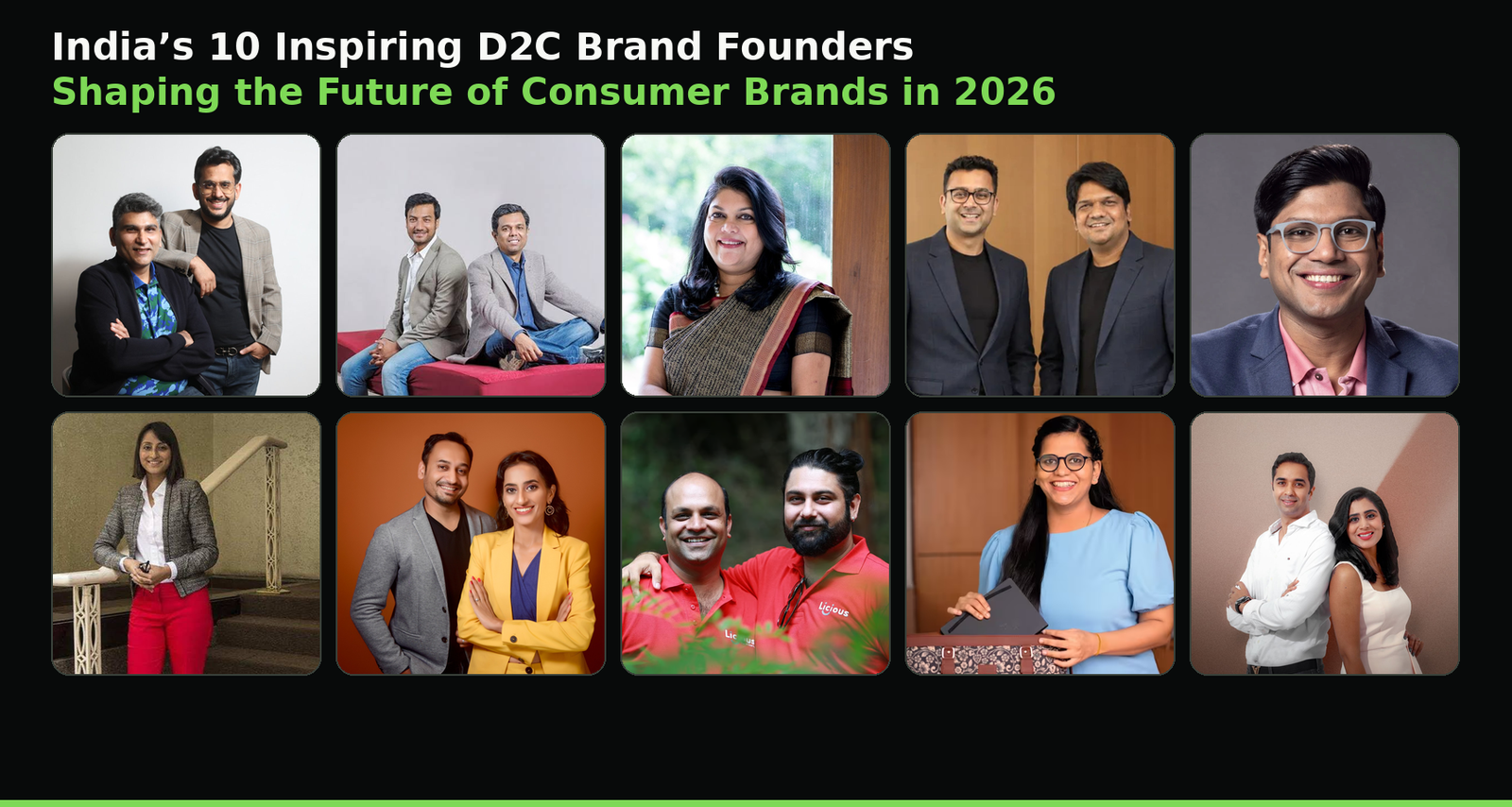
India’s direct-to-consumer (D2C) ecosystem is changing how people discover, purchase and connect with brands. From beauty and personal care to electronics, eyewear, fashion and home essentials, homegrown businesses are challenging traditional approaches with digital-first distribution, focused product offerings and customer-led innovation. The following editorial selection highlights ten notable Indian consumer-brand founders and founding teams whose businesses illustrate different approaches to building and scaling brands. They represent a cross-section of India’s evolving consumer economy, rather than a ranked list.
1. Aman Gupta and Sameer Mehta | boAt
Category: Consumer Electronics and Wearables
Aman Gupta and Sameer Mehta co-founded boAt in 2016, building a consumer electronics brand focused on accessible audio products and lifestyle-oriented design. Its portfolio expanded across earphones, headphones, speakers and wearables. The brand developed strong visibility among younger consumers through digital marketing, partnerships and broad online distribution. boAt illustrates how product positioning, pricing and brand personality can help a domestic company compete in a category with established international players. Its evolution also reflects the changing expectations of Indian consumers, who increasingly view electronics as both functional purchases and expressions of personal style.
2. Ankit Garg and Chaitanya Ramalingegowda | Wakefit
Category: Mattresses, Sleep and Home Solutions
Ankit Garg and Chaitanya Ramalingegowda co-founded Wakefit, a company that began with mattresses and expanded into furniture and other home products. The business challenged conventional buying habits by using online sales, direct customer communication and product-focused marketing. Home products often involve questions about comfort, durability and value, making trust and after-sales experience especially important. Wakefit’s model demonstrates how a digital-first brand can simplify the discovery and purchase process for products that customers traditionally preferred to evaluate through physical retailers. Its expansion illustrates the potential of extending a focused product proposition into adjacent home categories.
3. Falguni Nayar | Nykaa
Category: Beauty, Personal Care and Fashion
Falguni Nayar founded Nykaa in 2012, bringing her experience in investment banking to India’s beauty and retail sector. The company built its identity around beauty discovery, product information and access to a broad range of brands. It later expanded into fashion and developed its own product labels. Nykaa’s journey demonstrates how content, curated selection and customer trust can help shape an online shopping experience. Its growth also illustrates the potential of combining digital commerce with physical stores in a market where shoppers value both convenience and the ability to explore products before buying.
4. Shashank Mehta | The Whole Truth Foods
Category: Nutrition and Packaged Food
The Whole Truth Foods was founded by Shashank Mehta and focuses on nutrition products with an emphasis on ingredient transparency. Its brand communication encourages consumers to look beyond front-of-pack claims and understand what goes into the food they buy. In a category where packaging and marketing can strongly influence perception, clear ingredient communication can help differentiate a business. The brand’s approach illustrates how a consumer company can build its identity around a specific value proposition rather than competing on price alone. It also reflects growing interest in more informed food choices among Indian consumers.
5. Peyush Bansal | Lenskart
Category: Eyewear and Retail Technology
Peyush Bansal co-founded Lenskart to make eyewear more accessible through technology and an evolving retail model. The company combines online discovery and ordering with physical stores, eye-testing services and tools designed to help customers select frames. Eyewear presents a distinctive challenge for digital commerce because fit, prescription accuracy and after-sales support matter as much as price. Lenskart’s approach shows how a consumer brand can use technology to reduce purchasing friction while maintaining a physical presence. Its story offers lessons in building customer confidence in a category traditionally dominated by local optical retailers.
6. Richa Kar | Zivame
Category: Intimate Wear and Fashion
Richa Kar founded Zivame to address gaps in how women could discover and purchase intimate apparel in India. The brand used online commerce to offer a wider product selection and a more private shopping experience. Fit, comfort, product information and confidence are particularly important in this category, making the customer journey central to the brand’s proposition. Zivame’s story highlights how a founder can identify an underserved shopping need and use digital channels to respond to it. It also demonstrates that building a consumer brand sometimes requires changing established attitudes around how a product is discussed, selected and purchased.
7. Vineeta Singh and Kaushik Mukherjee | SUGAR Cosmetics
Category: Colour Cosmetics and Beauty
Vineeta Singh and Kaushik Mukherjee co-founded SUGAR Cosmetics, a beauty brand known for its contemporary identity and focus on makeup products for Indian consumers. The company developed a presence through online channels and subsequently expanded its offline retail footprint. In a crowded beauty market, brand identity, product selection and customer engagement can influence purchasing decisions as much as price. SUGAR’s journey highlights the opportunity for homegrown beauty companies to build recognisable identities for specific audiences. It also demonstrates how digital discovery and physical product access can work together as a brand grows.
8. Vivek Gupta and Abhay Hanjura | Licious
Category: Meat, Seafood and Fresh Food
Vivek Gupta and Abhay Hanjura co-founded Licious, developing a consumer-facing business around meat and seafood. The category presents operational challenges beyond online marketing, including sourcing, freshness, quality control and reliable delivery. Licious built its proposition around managing more of the customer experience, from product selection to fulfilment. Its journey illustrates that a D2C brand is not simply an online storefront. For products with demanding storage and handling requirements, supply-chain execution and customer trust are central to the business model. The company’s approach shows how technology and operations can work together in food commerce.
9. Disha Singh | Zouk
Category: Fashion, Bags and Lifestyle Accessories
Disha Singh founded Zouk, an Indian lifestyle brand known for bags, wallets and accessories inspired by contemporary design and Indian craftsmanship. The brand has built its identity around products that combine modern functionality with traditional Indian-inspired materials and aesthetics. Its digital-first approach allows it to connect directly with consumers looking for distinctive alternatives in the fashion accessories market. Zouk’s journey highlights how a focused product range, a clear brand identity and online customer engagement can help an emerging business establish its place in India’s competitive D2C ecosystem.
10. Ghazal Alagh and Varun Alagh | Mamaearth
Category: Beauty, Baby Care and Personal Care
Ghazal Alagh and Varun Alagh co-founded Mamaearth after their search for suitable products for their newborn highlighted their concerns about ingredients in baby care. Launched in 2016, the brand expanded into skincare, haircare and personal care, building its positioning around ingredient awareness and family-focused products. Its development reflects how a specific consumer concern can become the starting point for a broader brand proposition. Mamaearth’s journey also illustrates the role of digital marketing, online customer feedback and wider retail distribution in taking a young consumer brand beyond its original niche.
These businesses operate in different categories, but their journeys point to a shared lesson: sustainable consumer brands need more than online visibility. Product quality, clear positioning, reliable fulfilment, customer trust and repeat purchases all matter. As D2C companies expand through marketplaces, quick-commerce platforms, their own websites and physical retail, founders must balance customer acquisition with operational discipline. India’s next generation of consumer brands will be shaped by how effectively they understand local needs, earn loyalty and build businesses that can grow beyond their initial digital audiences.
Frequently Asked Questions (FAQs)
1. What does D2C mean in business?
D2C stands for Direct-to-Consumer, a business model in which brands sell products directly to customers through websites, online stores and other direct sales channels.
2. Who are some inspiring D2C brand founders in India?
Notable Indian consumer-brand founders include Aman Gupta and Sameer Mehta of boAt, Falguni Nayar of Nykaa, Peyush Bansal of Lenskart, and Ghazal Alagh and Varun Alagh of Mamaearth.
3. Which industries are popular in India’s D2C market?
Popular categories include beauty and personal care, fashion, food and beverages, consumer electronics, eyewear, home furnishings and lifestyle accessories.
4. What are the main challenges faced by D2C founders in India?
D2C founders often face challenges involving customer acquisition costs, competition, inventory management, logistics, customer retention and maintaining profitability.
5. How can D2C brands grow in India?
D2C brands can grow by offering quality products, building a recognisable brand identity, using digital marketing effectively, improving customer experience and expanding through suitable online and offline sales channels.