


Rising competition fragments loyalty in quick commerce
-
Startup Spotlight India
- May 20, 2026

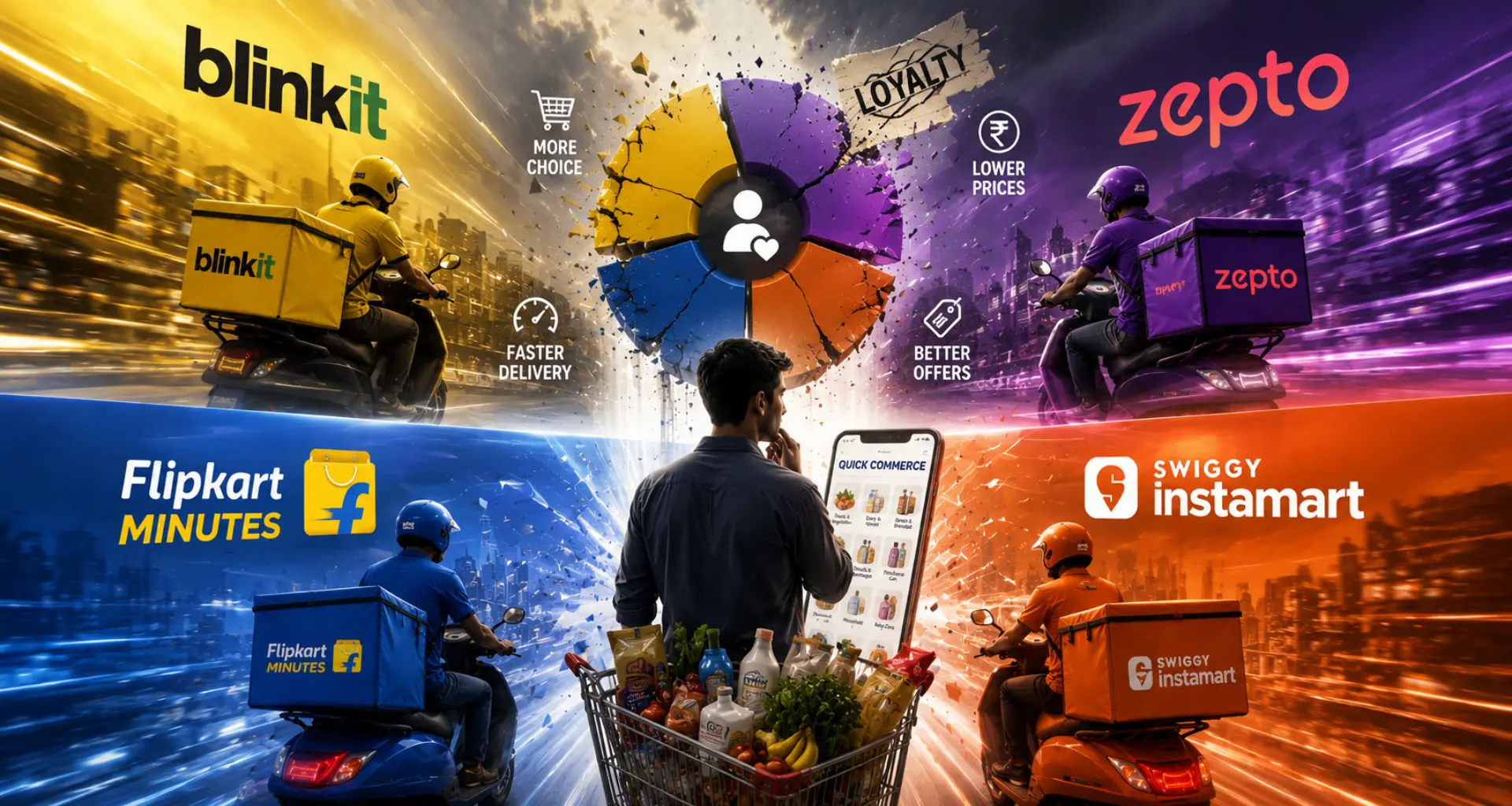
Quick commerce players Blinkit, Zepto, and Swiggy Instamart continue to scale aggressively, fueled by rapid dark store expansion and a surge in daily orders. However, intensifying competition is fragmenting customer loyalty across platforms.
While the overall quick commerce market is growing at a fast pace, consumers are increasingly splitting their purchases between multiple apps. This shift is reducing ordering frequency on individual platforms, even as total industry order volumes continue to climb.
Recent quarterly data from Blinkit and Swiggy Instamart highlights this trend. Blinkit’s monthly ordering frequency declined from 3.57 to 3.36 over the past year, despite a 42% jump in annual orders to 274 million. Similarly, Instamart’s frequency dropped from 4.22 to 4.01 across five consecutive quarters, even as total orders rose 54% to 113 million.
The slowdown in per-user frequency comes amid rising competition, with at least seven major players now operating at scale and collectively processing over 10 million orders daily, according to industry estimates.
In terms of scale, Blinkit leads the market with 2,243 dark stores and more than 3 million daily orders. Zepto has expanded to over 1,100 stores, handling around 2.4–2.5 million daily orders. Instamart operates 1,143 stores with approximately 1.25 million daily orders. BigBasket runs over 850 dark stores, while newer entrants like Flipkart Minutes and Amazon Now have scaled up rapidly over the past year.
This growing competition is expanding overall consumer engagement across apps rather than strengthening loyalty to any single platform.
According to data tracked by CLSA using Sensor Tower, Blinkit averaged 45.2 million weekly active users (WAU) during the March quarter, maintaining its lead. Zepto followed with around 33–34 million WAU, while BigBasket recorded the fastest sequential growth, reaching a record 20.4 million users in early May. The standalone Instamart app saw about 9–10 million users, excluding those accessing it via the main Swiggy app.
The data also reveals clear differences in user retention and engagement quality. Blinkit converts about 24% of its total downloads into weekly active users—the highest in the segment—closely followed by Zepto at 23%. Instamart stands at around 14%, while JioMart and DMart Ready lag behind.
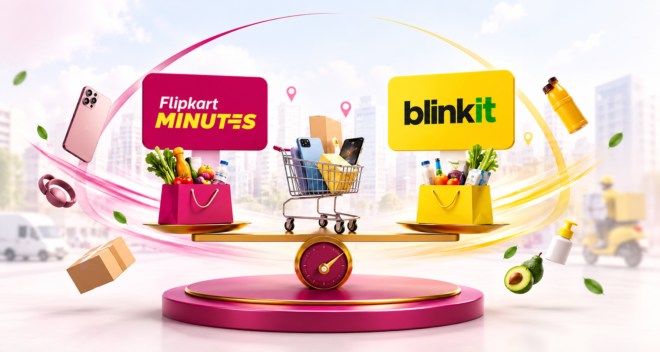
Analysts say these variations reflect distinct strategic approaches. Blinkit is prioritizing faster deliveries and broader assortment, while Instamart is focusing on higher-value baskets and private labels. BigBasket continues to leverage its strength in grocery depth and fresh produce, whereas newer entrants like Flipkart Minutes, Amazon Now, and JioMart are relying heavily on discounts and promotions to attract users.
Importantly, analysts note that declining ordering frequency on individual platforms does not signal weakening demand for quick commerce. Instead, it reflects evolving consumer behavior, where users switch between apps based on pricing, delivery speed, and product availability.
Among competitors, Zepto stands out for maintaining retention levels close to Blinkit despite its discount-heavy strategy. However, some analysts caution that this could come under pressure if promotional spending is reduced.