


XSCACE Develops Ultra-Slim Speakers With 40W to 50W Power Output
-
Khushi Jain

- October 12, 2026
For decades, brands such as Bose, Marshall, Bang & Olufsen and KEF have shaped the global audio industry. Their products have traditionally relied on larger cabinets, bigger drivers and speakers designed to be visible within a space to deliver high-quality sound.
However, this approach is increasingly at odds with modern interior design preferences. Architects and homeowners are opting for clean walls, minimal interiors and technology that integrates into a room rather than becoming its focal point.
This shift has created a challenge for the speaker industry. High-quality speakers typically require physical space to deliver the depth, power and clarity listeners expect. Attempts to reduce their size have often involved compromises in sound quality, leaving manufacturers with a trade-off between compact design and audio performance.
For Utkarsh Hora, cofounder of Canadian architectural audio startup XSCACE, audio has been part of his family history. His grandfather, Bansi Lal Hora, worked with Philips in Thailand before returning to India and starting a business repairing high-end audio equipment. His father, Manoj Hora, continued that legacy by building a business around premium audio installations.
During his time at the University of Toronto, Utkarsh began questioning whether high-performance audio systems needed to occupy so much space. That question eventually led to the founding of XSCACE in 2022, with the aim of developing speakers that deliver high-quality sound without dominating a room or compromising its design.
The challenge was rooted in a fundamental principle of speaker design known as Hoffman’s Iron Law. According to the principle, designers can optimise only two of three factors at a time: deep bass, a small enclosure and high efficiency. XSCACE set out to push the boundaries of this trade-off while maintaining sound quality.
After two years of development and testing, XSCACE made its first commercial sale in January 2024. The company now offers a range of ultra-compact speakers built around six proprietary technologies and is expanding its distribution across international markets.
How XSCACE Is Rethinking Speaker Design
When Utkarsh began his entrepreneurial journey, he observed that modern luxury spaces were becoming increasingly minimal. Architects and interior designers wanted clean walls, hidden wiring and fewer visible fixtures.
Speakers, however, remained difficult to conceal without compromising performance. In-wall and in-ceiling speakers offered an architectural solution, but products designed to blend into interiors could fall short on sound quality, while performance-focused speakers often required more space.
The underlying challenge was Hoffman’s Iron Law, which describes the trade-off between speaker size, bass response and efficiency. Improving one factor typically requires a compromise elsewhere.
Rather than accept these limitations, Utkarsh began by rethinking the speaker’s central component: the driver.
Instead of optimising individual components independently, XSCACE approached the speaker as an interconnected system. Driver geometry, motor design, cone materials, crossover architecture, cabinet construction and thermal management were developed together, with each element designed to work within the constraints of the others.
“We didn’t eliminate the trade-off altogether but became far more intentional about where it exists,” the founder said.
This approach led to the development of six proprietary technologies, each addressing a different aspect of speaker performance.
- Nano Resonance: Focuses on ultra-compact driver performance.
- PowerDense Dynamics: Extracts higher output from miniature motors.
- AeroFrame Chassis: Reduces resonance.
- PrecisionXover Array: Enables seamless driver integration.
- XS-Flow: Addresses airflow and bass response.
- PsySculpt: Creates a more convincing spatial experience through psychoacoustic tuning.
Nano Resonance was among the most challenging technologies to develop, according to Utkarsh. The objective was to achieve deep bass, high output and low distortion from a miniature driver while maintaining long-term reliability.
From Prototype to Production
Developing a prototype that performs well under controlled conditions does not guarantee that the same performance can be reproduced consistently at scale.
XSCACE therefore had to adapt its engineering approach to account for manufacturability and repeatability. This required revisiting aspects of the product design to ensure that the manufacturing process could deliver consistent results without compromising performance.
“It’s one thing to build a prototype and altogether a different ball game to build the exact same product at scale,” Utkarsh said.
The development process involved spending on simulation, prototyping, testing and refinement across acoustics, mechanical design, materials and manufacturing. It also required building a multidisciplinary team and investing in engineering capabilities.
Following experimentation and testing, the company developed two products, Bonsai and Cane, from early experimental concepts into products ready for manufacturing and commercial sale.
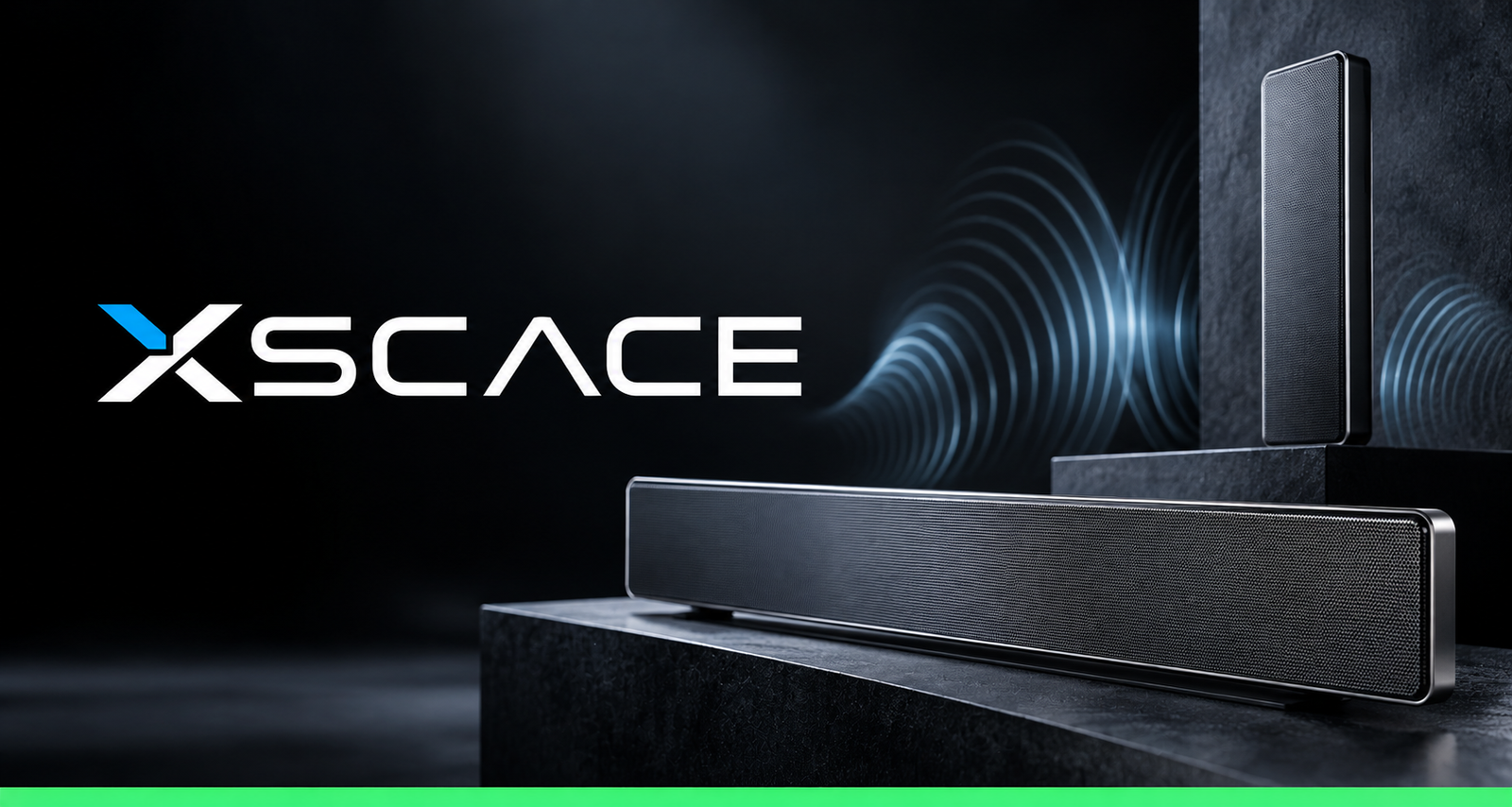
Bonsai is an ultra-slim speaker that is 12 mm deep and delivers 40W of output. It is designed to be mounted discreetly on walls or installed within walls or ceilings.
Cane is a slightly larger, 23 mm-thin slim-array speaker with 50W output. It is designed for spaces that require higher output while keeping the speaker visually unobtrusive.
Building an Audio Software Ecosystem
Utkarsh’s approach extends beyond compact speaker hardware. From the outset, he viewed software as an extension of XSCACE’s product portfolio.
“I did not want our products to depend entirely on third-party software,” he said.
The company subsequently began developing an in-house software ecosystem. Its current offerings include an AI Configurator that helps architects, designers and integrators plan and configure audio systems, a companion app for users, and the Xylem DSP Controller, which allows installers to fine-tune sound according to a room’s acoustics.
Over time, XSCACE expects the AI Configurator to evolve beyond planning and support installation, calibration, optimisation and ongoing system management.
The software strategy is also linked to the company’s broader ambitions. Utkarsh said the five-year vision is to establish XSCACE as a global reference in premium architectural audio.
The company plans to expand beyond loudspeakers into software, digital signal processing (DSP), amplification and complementary products. It also aims to strengthen its presence in India while expanding across the US, Europe and the Middle East.
For Utkarsh, growth is not measured solely through revenue or market expansion. He also considers engineering capabilities, intellectual property, product consistency and the trust built with architects, integrators and customers.
XSCACE’s approach centres on challenging the assumption that high-performance audio must remain visually prominent. As the company expands from compact architectural speakers towards a broader audio ecosystem, it continues to focus on integrating sound performance with minimal design.
FAQs
1. What is XSCACE?
XSCACE is a Canadian architectural audio startup founded by Utkarsh Hora in 2022. It develops compact speakers designed to deliver high-quality sound while integrating into modern interiors.
2. Who founded XSCACE?
XSCACE was founded by Utkarsh Hora in 2022. His family has a background in high-end audio equipment repair and premium audio installations.
3. What are XSCACE’s Bonsai and Cane speakers?
Bonsai is a 12 mm-deep speaker with 40W output, while Cane is a 23 mm-thin slim-array speaker with 50W output. Both are designed to remain visually unobtrusive.
4. What are the six proprietary technologies developed by XSCACE?
The six technologies are Nano Resonance, PowerDense Dynamics, AeroFrame Chassis, PrecisionXover Array, XS-Flow and PsySculpt.
5. What are XSCACE’s expansion plans?
XSCACE aims to expand beyond loudspeakers into software, DSP, amplification and complementary products, while strengthening its presence in India and expanding across the US, Europe and the Middle East.