




Supreme Court Orders Red Warning Labels on Packaged Foods High in Sugar Salt and Fat
-
Khushi Jain

- November 27, 2026
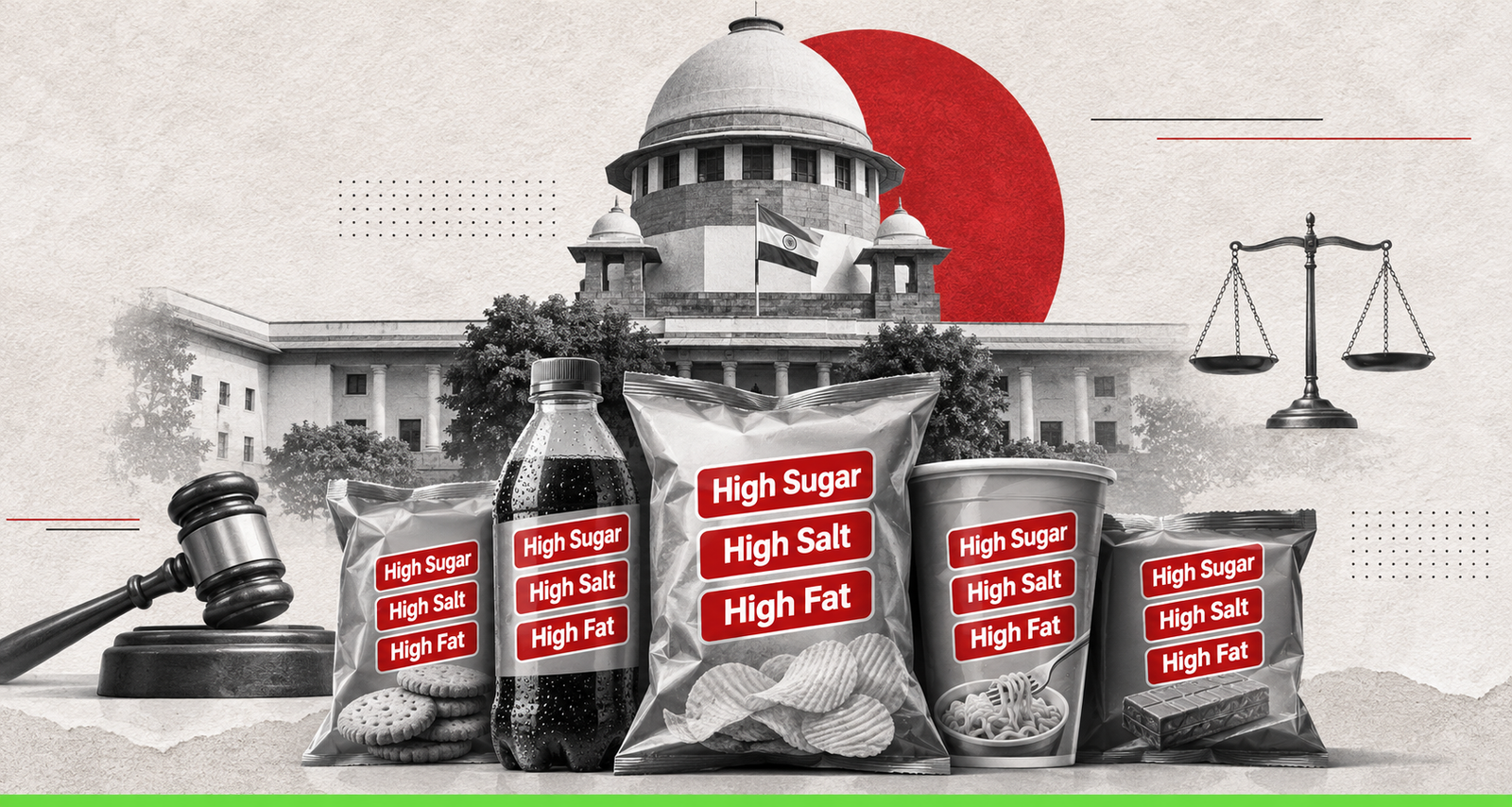
The Supreme Court has directed the Food Safety and Standards Authority of India (FSSAI) to introduce front-of-package warning labels for packaged foods containing high levels of sugar, saturated fat and salt.
The court has given FSSAI four months to frame the rules and allowed food companies one year from the date of notification to make the labels compulsory.
Under the proposed system, packaged foods exceeding prescribed nutrient limits will carry separate red, hexagon-shaped warning labels on the front of their packaging.
According to a Reuters report, the ruling requires individual warnings for each nutrient of concern rather than a single combined label.
Supreme Court Directs FSSAI to Introduce Separate Warning Labels
A bench comprising Justices J B Pardiwala and K Vinod Chandran directed FSSAI to introduce clear warning labels that help consumers identify packaged foods containing high levels of sugar, saturated fat and salt.
The court rejected the regulator’s proposal to use a single hexagonal label covering all three nutrients.
Instead, it directed that each nutrient of concern must have a separate red hexagon on the front of the package.
The warnings will identify whether a product contains high levels of sugar, saturated fat or salt.
The court also directed FSSAI to ensure that the text inside the warning labels is clear, prominent and easily readable alongside pictorial representations.
According to a LiveLaw report, the bench emphasised that warning labels must provide clear information about the nutrients of concern.
FSSAI Gets Four Months to Frame Food Labelling Rules
The Supreme Court has granted FSSAI four months to complete the regulatory process required under the Food Safety and Standards Act, 2006, and the applicable regulations.
The court also accepted the proposed implementation timeline for food business operators.
Under the arrangement, companies will receive one year from the date of notification to implement the mandatory warning labels.
The intervening 365 days will be treated as a voluntary implementation period.
However, the bench stressed that FSSAI must follow the prescribed timeline and take steps to address potential delays.
The court also noted that every additional delay would allow packaged foods to continue being sold without the proposed warning labels.
Supreme Court Raises Concerns Over Packaged Food Consumption
The Supreme Court expressed concern about the public health effects of consuming foods high in saturated fat, sugar and salt.
The bench said India was facing a major public health crisis, partly driven by the consumption of such products.
It observed that protecting consumers requires preventive measures and better information about the contents of packaged food.
The court also highlighted the importance of protecting people from business practices that may adversely affect their health.
It said the judiciary could not remain a “mute spectator” in a situation involving public health and consumer rights.
The bench emphasised that food safety regulations should help people make informed choices about the products they consume.
- FSSAI Begins Nationwide Packaged Drinking Water Quality Checks, Results Expected in 1-2 Months
- FSSAI Issues Notices to BigBasket, Flipkart Over Oil Claims
- PepsiCo Warns of Energy Drink Shortages in India Within Two Months
- FSSAI Considers Stricter Food Safety Rules for Ecommerce Platforms and Cloud Kitchens
Court Links Food Labelling to Consumer Rights
The Supreme Court said the proposed warning labels were connected to the rights to health, food and informed choice.
It observed that the right to health extends beyond healthcare services to include conditions necessary for maintaining good health.
Similarly, the court said the right to food includes access to food that is adequate in both quantity and quality.
The right to informed choice also requires consumers to have access to information that helps them understand the products they purchase.
The bench raised concerns that packaged foods were continuing to be sold without prominent warnings about high levels of sugar, saturated fat and salt.
According to The Indian Express, the court directed FSSAI to introduce separate warning labels instead of combining multiple nutrient warnings into one symbol.
FSSAI Asked to Avoid Further Delays
The Supreme Court expressed concern over what it described as FSSAI’s reluctance to introduce a warning-label system already followed in several countries.
It directed the regulator to fulfil its responsibility to protect consumers and ensure the rules are implemented within the agreed timeline.
The bench said FSSAI should anticipate potential obstacles and take steps to resolve them before they delay implementation.
The court also rejected the proposal for a single warning symbol containing information about high sugar, high saturated fat and high salt.
Instead, food packaging will need separate red hexagons for each nutrient exceeding the prescribed limits.
The font size must remain clear and easily readable alongside the relevant pictograms.
The ruling establishes a timeline for introducing front-of-package nutrition warnings, with four months for FSSAI to complete the rulemaking process and a further one-year implementation period for food businesses after notification.
Frequently Asked Questions (FAQs)
1. What has the Supreme Court ordered regarding packaged food labels?
The Supreme Court has directed FSSAI to introduce separate front-of-package warning labels for foods containing high levels of sugar, saturated fat and salt.
2. How much time has the Supreme Court given FSSAI?
FSSAI has been given four months to frame the rules under the applicable food safety law and regulations.
3. When will food warning labels become compulsory in India?
Food companies will have one year from the date of notification to implement the mandatory warning labels. The intervening 365 days will be a voluntary implementation period.
4. What will the new packaged food warning labels look like?
The warnings will appear in separate red hexagons, with clear text and pictorial representations identifying the nutrients of concern.
5. Why did the Supreme Court order separate food warning labels?
The court said clear labelling was necessary to protect public health and help consumers make informed decisions about packaged food.